



 26 October ,2026
 Depreet Singh
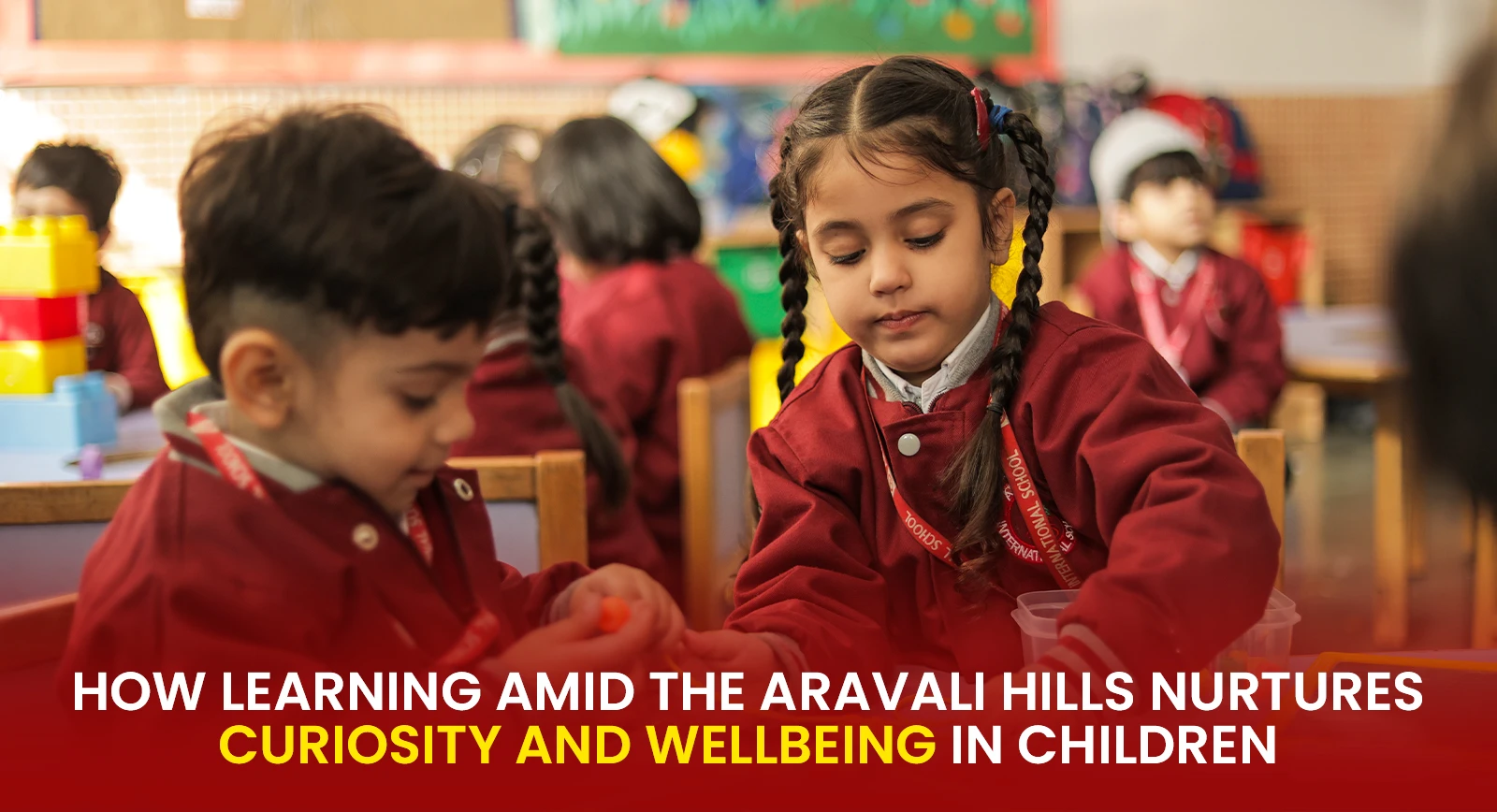
When did your child last come home with muddy shoes and a story to tell?
Not a screen story. A real one. About a beetle under a rock, a strange bird call or a tree that seemed taller than yesterday.
For many Faridabad families, those stories have become rare. Childhood has quietly moved indoors, into apartments, cars and air-conditioned rooms.
Yet just off Surajkund Road, the Aravali hills still roll along the city's edge. And they raise a question worth asking as you compare schools in Faridabad Sector 43 and beyond.
“Does where a child learns shape how they learn?”
Research suggests it can. Here is what it says, what it means for your child and what to look for in a school.
What Research Says About Green Spaces and Learning
Two studies are worth knowing about.
In 2015, researchers in Barcelona followed more than 2,500 children aged 7 to 10 for a year. Children whose schools had more greenery around them showed greater gains in working memory and attention, according to the study published in PNAS.
The researchers were careful to call this an association, not proof of cause. Lower traffic pollution near greener schools explained part of the effect.
In 2019, a review in Frontiers in Psychology by Ming Kuo and colleagues brought together a wide body of evidence. It found that nature-based learning appears to support focus, lower stress, strengthen self-discipline and raise motivation, though results vary by setting and activity.
So green surroundings are not a magic fix. They give children chances to observe, explore and connect with nature. Their real educational value comes when teachers intentionally bring those experiences into everyday learning.
Four Ways Nature Experiences Can Support Children's Development
- Curiosity that starts on its own A feather, a seed pod or an ant trail can spark more questions than a worksheet. Children who notice more often go on to ask more.
- Focus that lasts longer Time outdoors can help restless minds reset, which is one reason outdoor learning for children features in so much recent research.
- Confidence in small doses Age-appropriate outdoor activities can give children chances to solve problems, handle small challenges and gradually build confidence.
- Calm that carries indoors Fresh air, open sky and room to move can ease the pressure many children carry from packed schedules and long commutes.
This is also where experiential learning in schools comes alive. A lesson on plants means more when a child can touch the leaf, measure its shadow and sketch what they see.
A Season-by-Season Reality Check
Faridabad parents know the hills are not always inviting. Any honest conversation about learning outdoors has to include the weather.
- Summer: From April to June, the heat makes long outdoor sessions unsafe. Look for schools that shift outdoor time to early mornings and shaded spaces.
- Monsoon: From late June to September, the hills turn green and the fields turn muddy. It is a rich time to observe plants, insects and water, with sensible safety rules.
- Winter: November to January often brings poor air quality across the NCR. Ask how a school tracks AQI and moves activities indoors on bad days.
- Spring: February and March are often the best months for long nature walks and outdoor projects.
These are broad patterns, and conditions change from year to year. The day's weather and AQI should always decide. A school that takes nature seriously should take these limits just as seriously.
Bringing a Little of the Hills Home
School is only part of the picture. A few small habits at home can keep that curiosity going all week.
- Start a nature notebook: Give your child a small notebook for sketching the leaves, birds and clouds they spot in your society park.
- Grow something together: A tulsi plant or a pot of methi on the balcony teaches patience, care and a little science along the way.
- Swap one screen hour: Trade one evening of cartoons for a short walk where your child chooses the route and leads the way.
- Plan a weekend trail: Asola Bhatti Wildlife Sanctuary, just across the Delhi border, is a short drive from much of Faridabad. Check visiting timings and go early in the cooler months.
- Ask better questions: Instead of "What did you learn today?", try "What did you notice outside today?" The answers are often far more interesting.
None of this needs a big plan or a big budget. It just needs a little time outside, together, with your phone in your pocket.
Learning at Aravali's Sector 43 Campus
For families weighing schools in Faridabad Sector 43, the setting of Aravali International School is hard to miss.
The Sector 43 campus sits on Badkal Surajkund Road, amid the Aravali hills, across 13 acres that the school describes as integrated with nature.
- Space to move: Sports fields, courts and a swimming pool give children room to play, compete and build fitness.
- Many ways to explore: Science and computer labs, a library, a Creative Arts Studio and a Theatre Club let children approach ideas from different angles.
- Learning by doing: The school's learning pathway is built on inquiry-based and project-based learning, with STEM, coding and year-long Global Perspective projects.
- Care beyond academics: Guidance and counselling, along with a Building Personal Mastery programme, support each child's wellbeing and self-awareness.
Together, these facilities and the natural setting create opportunities for nature-inspired education that combines classroom learning, physical activity and exploration.
When you visit, ask how classes use the outdoor spaces at your child's grade level. The answer will tell you a lot.
Questions Parents Often Ask
What should I check when visiting schools in Faridabad Sector 43?
Look at how outdoor spaces are actually used, not just how they look. Ask about shade, drinking water, summer timings and the school's plan for high-AQI days. And drive the route at school hours to see the real commute.
Is nature-based learning only for young children?
Not at all. Older students use the outdoors for science fieldwork, geography projects and environmental studies. A walk in the open can also help teenagers reset during heavy exam seasons.
How much outdoor learning for children is enough?
There is no single number. Short, regular time outside across the week often matters more than an occasional long trip. What counts is that it is planned and purposeful.
Does experiential learning in schools affect exam results?
It is meant to build understanding, not replace exam preparation. When children have seen and handled a concept, it is often easier to recall and apply, including in exams.
Is nature-inspired education practical in Faridabad's heat and pollution?
Yes, with sensible planning. The best approach adjusts outdoor time to the season and the air quality, and moves learning indoors when conditions are unsafe.
Let Your Child Learn Where Curiosity Grows
Children do not need a forest to learn. But a little sky, some open ground and a hill on the horizon can change how a school day feels.
The habits children form in those early years, noticing, wondering, and asking, tend to stay with them long after they leave school.
If you are exploring schools in Faridabad Sector 43, come and see the Aravali International School campus for yourself. Walk the grounds, meet the teachers, and picture your child learning there.
Book your visit through the Sector 43 admission enquiry form, and let your child's next story begin with muddy shoes.