

 21 October ,2026
 Depreet Singh
It usually starts at a birthday party. Or in the society WhatsApp group.
One parent has just moved their son to a Cambridge programme.
Another is certain CBSE is the only safe road to IIT.
Someone's niece in Gurugram is doing the IB and, apparently, loves school for the first time.
And by the time you are driving home along Surajkund Road, one question refuses to leave you alone.
“Is an international curriculum right for my child, or is it just what everyone is talking about this year?”
You are not the only parent asking.
Not long ago, an international programme meant a daily commute into Delhi. Today, the shortlist of international schools in Faridabad sits right alongside trusted CBSE options.
More choice is good news. It also makes the decision harder. So let's make it simpler.
First, What Does "International" Actually Mean?
In India, it usually points to one of two frameworks.
The IB (International Baccalaureate)
The IB offers four programmes: Primary Years, Middle Years, Diploma, and Career-related. A school may offer one or more of them, so check which ones cover your child's age group.
IB curriculum schools put inquiry first. Children explore big ideas, ask open questions and connect subjects to each other and to the world around them.
Cambridge International
Part of the University of Cambridge. A step-by-step pathway from Cambridge Early Years through IGCSE and A Levels.
It is subject-based, with internationally recognised qualifications. In the senior years, IGCSE and A Level examinations can be demanding.
So the two are not the same thing. Both encourage real understanding, critical thinking and independent learning. But the IB leans towards inquiry and links between subjects, while Cambridge offers subject-by-subject depth with recognised exams.
What Your Child Actually Gains
The benefits of international education rarely show up first on a report card. They show up in how a child thinks, speaks, and handles a new problem.
- Confidence: Regular presentations and class discussions help children speak up and defend an idea.
- Sharper thinking: Children learn to explain how they reached an answer, not just what it is.
- A wider outlook: Examples from many countries help them feel at home anywhere, from Delhi to Toronto.
- Different ways to show learning: Depending on the programme, students may be assessed through projects, coursework, presentations and exams.
One honest caveat. None of this is automatic.
“The board sets the framework. The teachers decide how much of it your child actually gets.”
International or CBSE? An Honest Comparison
Any fair look at the international vs CBSE curriculum question has to start by giving CBSE its due.
It is the national standard, and its syllabus is often more closely aligned with common entrance exams like JEE, NEET, and CUET.
That is not the same as automatic preparation, though. Schools differ in how much support they give. And CBSE moves easily with you if a job transfer takes the family to another city.
It is also changing. In June 2025, CBSE approved twice-a-year Class 10 board exams from 2026, in line with NEP 2020. Students now get a second chance to improve their scores.
|
Factor |
CBSE |
IB / Cambridge |
|
Curriculum approach |
Nationally structured, increasingly competency-focused |
Varies by programme; inquiry, conceptual learning and subject depth |
|
Assessment |
Board examinations and school-based assessments |
Exams, coursework and other assessments, depending on the programme |
|
Indian entrance exams |
Often more closely aligned with common entrance-exam syllabi |
May need additional syllabus-specific preparation |
|
University abroad |
Recognised by many universities abroad |
Internationally recognised, subject to each university's requirements |
|
Fees |
Vary by school |
Vary by school and programme; compare actual fees |
How Aravali Brings Global Learning Into Its Academic Pathway
For a lot of parents, the honest answer isn't either one or the other.
They want the curiosity and confidence associated with international curriculum schools. And they want a strong academic pathway that prepares children for what comes next in India.
At Aravali International School, the approach combines Cambridge Early Years education with a broader learning pathway built on experiential learning and global perspectives. The two stages are distinct, and each plays its own part.
- Early years, the Cambridge way: The Cambridge Early Years programme gives the youngest learners hands-on play, exploration and teachers trained to Cambridge standards.
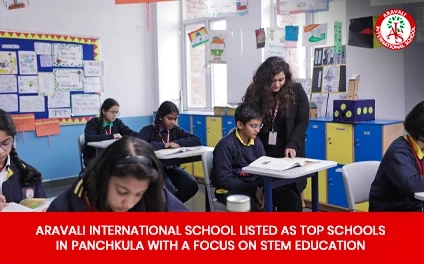
- Grade 3 to Grade 12, Aravali's own pathway: Aligned with NEP 2020, it carries that curiosity forward through project-based learning, STEM labs, coding and year-long Global Perspective projects.
- Learning beyond marks: Guidance and counselling, plus a Building Personal Mastery programme, help students find their strengths well before career decisions arrive.
- Close to home: Campuses in Sector 43 on Surajkund Road, set against the Aravali hills, and in Sectors 81 and 85 in Greater Faridabad. Ask the admissions team which campus offers Cambridge Early Years for your child's age group.
For parents comparing international schools in Faridabad, that mix of global teaching and a campus down the road is often what tips the decision.
Quick Answers to Common Questions
What should I look for when comparing international schools in Faridabad?
Look past the brochure. Ask which framework each grade follows, how teachers are trained and how students are prepared for Class 10 and 12. And try the route at the hour your child would actually travel.
Are international curriculum schools only for children planning to study abroad?
Not at all. Communication, research and problem-solving skills matter just as much at Indian universities and workplaces. Many families choose the approach for how it teaches, not where it leads.
At what age do the benefits of international education matter most?
The early years. This is when children form their attitude towards learning, and play-based, inquiry-led classrooms build curiosity that lasts.
Do IB curriculum schools prepare students for JEE and NEET?
The IB Diploma is recognised by the Association of Indian Universities for admission, but its content isn't designed around Indian entrance exams. Students aiming for JEE or NEET usually need extra, focused preparation.
How should parents weigh the international vs. CBSE curriculum choice?
Start with your child, not the board. Look at how they learn, where higher studies might happen, and what your family can sustain over the full school years. Then visit schools and see each approach in action.
Find the Fit, Not the Trend
There is no single right curriculum. There is only the right fit for your child.
So visit. Sit in on an activity. Watch how children and teachers talk to each other.
If you are shortlisting international schools in Faridabad, put Aravali International School on that list. Meet the teachers, see the classrooms, and bring every question this guide raised.
Book a campus visit or start your enquiry on the Aravali admissions page and see whether it feels right for your child.
5 Questions to Ask Before You Decide
Forget what the neighbours chose. Start here.
How does your child learn best?
Curious builders and talkers often thrive with inquiry-based learning. Children who like clear structure may settle faster with a familiar syllabus.
Where might higher studies happen?
Eyeing engineering or medicine in India? Ask how the school supports entrance prep. Thinking abroad? International exposure helps.
Could your family relocate?
Families in transferable jobs often value a board recognised in every Indian city.
What does the full budget look like?
Compare fees from Nursery to Class 12, transport and activities included. Not just the admission year.
How long is the daily drive?
Anyone who has crossed the Badarpur border at 7:30 am knows what a long commute costs a child in sleep. A campus nearby gives those hours back.